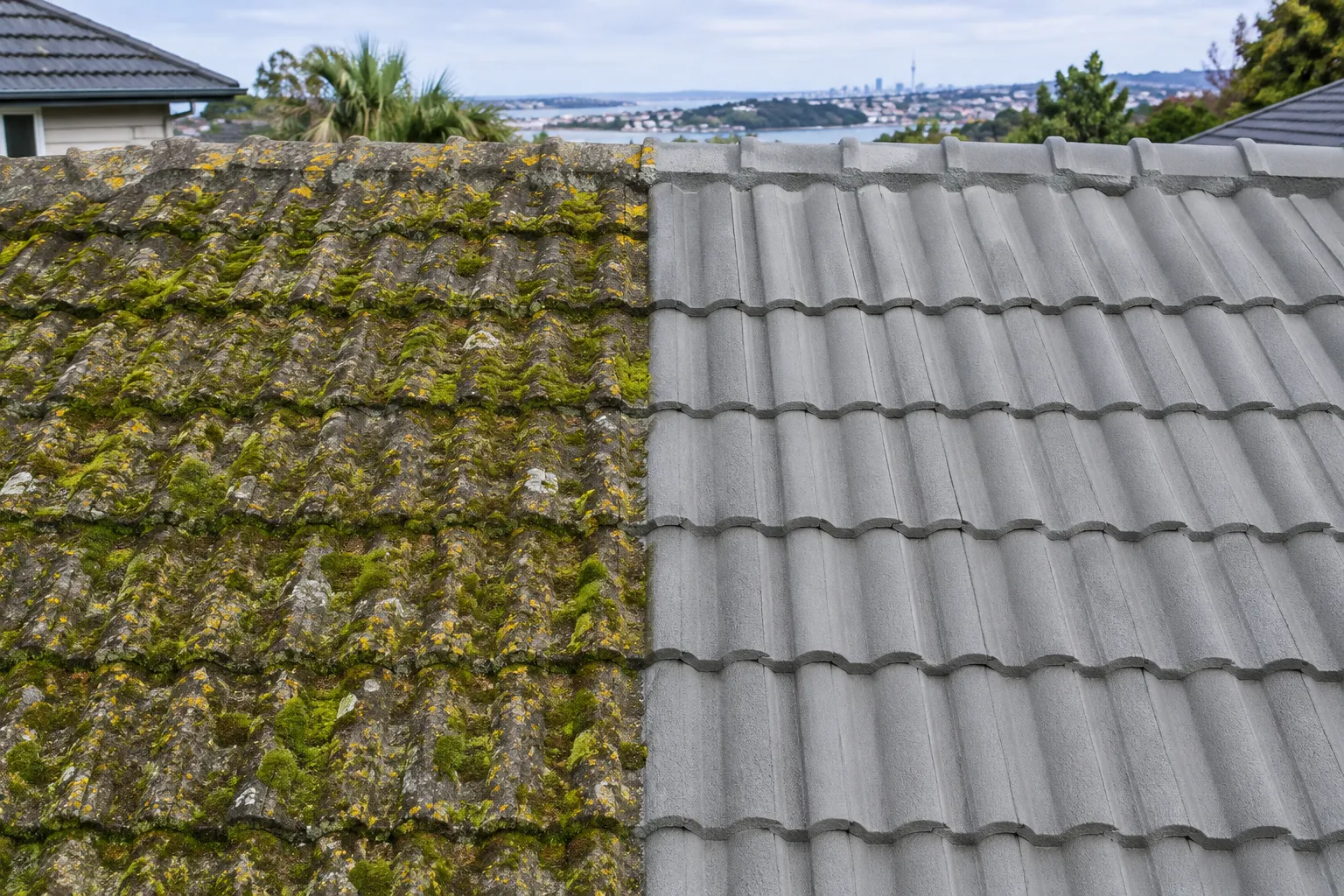
To paint a concrete tile roof, you treat moss and lichen, water blast the tiles clean, replace cracked tiles and fix loose ridges, let the roof dry completely, apply a sealer coat, then two topcoats of roof paint. It is a big job on a slippery, breakable surface, so safe access matters as much as the paint. This guide sits under our main page on tile roof painting in Auckland, which covers costs and the paint systems in more depth. Here you will find the steps, the mistakes that cause peeling, and the signs that a tile roof is a job for a specialist.
How do you seal a concrete tile roof?
You seal a concrete tile roof by applying one coat of a cement roof sealer to clean, completely dry tiles, before the topcoats go on. Resene's system is one coat of its solventborne Sureseal, then two coats of Summit Roof. The sealer binds the porous, eroded surface of old concrete tiles, so the paint grips instead of peeling.
Why the sealer matters on tiles:
- Old concrete tiles lose their surface over the years and become powdery.
- Paint on a powdery surface lifts away with the powder.
- The sealer soaks in and binds that surface together.
If you want to keep the tile colour instead, a clear water repellent is an option. Resene notes these need a maintenance coat every two to three years.
Can I paint my concrete tile roof myself?
You can paint a concrete tile roof yourself if the roof is low and easy to reach, you can set up safe edge protection, and you have the time to clean and dry it properly. The difficulty is not the painting. It is walking safely on tiles that can crack, and water blasting a whole roof without flooding the drains or damaging the tiles.
Ask yourself:
- Is the roof single storey with a gentle pitch?
- Can you set up scaffolding or edge protection? WorkSafe expects it even on single-storey buildings.
- Do you know how to walk on tiles without cracking them? Step on the lower part of each tile, where it is supported.
- Is the house older? If so, check whether any roofing contains asbestos before you clean.
If the answer to any of these is no, get quotes from a specialist instead.
What are the steps to paint a tile roof?
The steps are: set up safe access, treat moss and lichen, water blast, repair, dry, seal, then apply two topcoats. Each step depends on the one before it. Skipping the moss treatment or painting damp tiles are the two mistakes that most often make a tile roof peel within a few years.
- Set up safe access with scaffolding or edge protection.
- Treat moss and lichen and give it time to work. Lichen can take weeks to loosen fully.
- Protect the stormwater drains. Auckland Council's guidance is that wash water must not go into downpipes or drains, so divert downpipes to unsealed ground or block the drains and remove the water.
- Water blast the tiles to remove dirt, dead growth and loose coating. Resene says this is the best preparation for weathered cement roof surfaces. Keep the jet moving so you do not erode the tiles.
- Repair: replace cracked or broken tiles, and re-bed or re-point loose ridge caps.
- Let the roof dry completely. Concrete tiles hold moisture after washing.
- Seal the whole roof with one coat of a cement roof sealer.
- Apply two topcoats of roof paint, by airless spray or roller.
What causes tile roof paint to peel?
Tile roof paint usually peels because it went onto a surface that was dirty, powdery, mossy or damp, or because the sealer coat was skipped. It can also peel when old coatings underneath were loose. The fix is to clean the roof back to sound tile, let it dry, seal it and repaint. Painting over peeling paint only delays the problem.
Common causes, and how to avoid them:
| Cause | How to avoid it |
|---|---|
| Moss or lichen still on the tiles | Treat and allow time before cleaning |
| Powdery tile surface | Apply a cement sealer coat |
| Damp tiles | Wait until the tiles are thoroughly dry |
| Loose old coating underneath | Water blast it off first |
| Rain or dew before the paint dried | Watch the forecast and avoid early mornings |
Is there any safety risk in cleaning a tile roof?
Yes, two main ones: falls and asbestos. Wet, mossy tiles are slippery and can crack underfoot. WorkSafe New Zealand expects fall risks on roofs to be managed with edge protection where practicable. It also warns that high pressure water blasting, over 350 kPa or about 50 psi, must not be used on any roofing that contains asbestos. Some older decramastic tiles may contain it.
If your house is older and you are not sure what the roof is made of, get it checked before any cleaning starts. A specialist can arrange testing and choose a safe cleaning method.
When should a tile roof be left to a specialist?
Leave a tile roof to a specialist when it is steep or two storeys, when many tiles are cracked or ridges are loose, when the house is old enough that asbestos is possible, or when you cannot set up safe edge protection. A specialist brings the scaffolding, the water blaster, the spray gear and spare tiles, and usually finishes in a few days of work.
Questions people ask
How long does tile roof painting take?
A specialist usually needs a few days of work for a typical tile roof, spread over a week or two because the tiles must dry after washing and the weather has to cooperate. Moss treatment may need time to work before cleaning. Doing it yourself, plan for several weekends.
Can roof tiles be painted while wet?
No. Concrete tiles should be thoroughly dry before the sealer or paint goes on. Moisture trapped in the tile stops the coating bonding properly and is a common cause of peeling. After water blasting, allow a good spell of dry weather before sealing.
Do I need to be home while my roof is painted?
Usually not, as long as the specialist can reach the roof and has access to an outdoor tap and power if needed. You should close windows, move cars away from the house, and bring in washing during spraying. Agree these details when you accept the quote.
What should I ask before I hire someone to paint a tile roof?
Ask which sealer and topcoat they will use and how many coats, how many tiles they expect to replace, how they will keep wash water out of the drains, how they will manage working at height, whether they will check for asbestos on older roofs, and what warranty covers their workmanship. Get the answers in writing.
Sources used
Last changed